Lazy ordered single-linked list. More...
#include <cds/intrusive/impl/lazy_list.h>
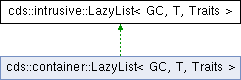
Public Types | |
| typedef GC | gc |
| Garbage collector. | |
| typedef T | value_type |
| type of value stored in the list | |
| typedef Traits | traits |
| Traits template parameter. | |
| typedef traits::hook | hook |
| hook type | |
| typedef hook::node_type | node_type |
| node type | |
| typedef implementation_defined | key_comparator |
| key comparison functor based on opt::compare and opt::less option setter. | |
| typedef traits::disposer | disposer |
| disposer | |
| typedef get_node_traits< value_type, node_type, hook >::type | node_traits |
| node traits | |
| typedef lazy_list::get_link_checker< node_type, traits::link_checker >::type | link_checker |
| link checker | |
| typedef traits::back_off | back_off |
| back-off strategy | |
| typedef traits::item_counter | item_counter |
| Item counting policy used. | |
| typedef traits::memory_model | memory_model |
C++ memory ordering (see lazy_list::traits::memory_model) | |
| typedef traits::stat | stat |
| Internal statistics. | |
| typedef gc::template guarded_ptr< value_type > | guarded_ptr |
| Guarded pointer. | |
Public Member Functions | |
| LazyList () | |
| Default constructor initializes empty list. | |
| ~LazyList () | |
| Destroys the list object. | |
| bool | insert (value_type &val) |
| Inserts new node. More... | |
| template<typename Func > | |
| bool | insert (value_type &val, Func f) |
| Inserts new node. More... | |
| template<typename Func > | |
| std::pair< bool, bool > | update (value_type &val, Func func, bool bAllowInsert=true) |
| Updates the item. More... | |
| bool | unlink (value_type &val) |
Unlinks the item val from the list. More... | |
| template<typename Q > | |
| bool | erase (Q const &key) |
| Deletes the item from the list. More... | |
| template<typename Q , typename Less > | |
| bool | erase_with (Q const &key, Less pred) |
Deletes the item from the list using pred predicate for searching. More... | |
| template<typename Q , typename Func > | |
| bool | erase (const Q &key, Func func) |
| Deletes the item from the list. More... | |
| template<typename Q , typename Less , typename Func > | |
| bool | erase_with (const Q &key, Less pred, Func func) |
Deletes the item from the list using pred predicate for searching. More... | |
| template<typename Q > | |
| guarded_ptr | extract (Q const &key) |
Extracts the item from the list with specified key. More... | |
| template<typename Q , typename Less > | |
| guarded_ptr | extract_with (Q const &key, Less pred) |
Extracts the item from the list with comparing functor pred. More... | |
| template<typename Q , typename Func > | |
| bool | find (Q &key, Func f) |
Finds the key key. More... | |
| template<typename Q , typename Less , typename Func > | |
| bool | find_with (Q &key, Less pred, Func f) |
Finds the key key using pred predicate for searching. More... | |
| template<typename Q > | |
| bool | contains (Q const &key) |
Checks whether the list contains key. More... | |
| template<typename Q > | |
| guarded_ptr | get (Q const &key) |
| template<typename Q , typename Less > | |
| guarded_ptr | get_with (Q const &key, Less pred) |
Finds key and return the item found. More... | |
| void | clear () |
| Clears the list. | |
| bool | empty () const |
| Checks if the list is empty. | |
| size_t | size () const |
| Returns list's item count. More... | |
| stat const & | statistics () const |
| Returns const reference to internal statistics. | |
Static Public Attributes | |
| static constexpr const size_t | c_nHazardPtrCount = 4 |
| Count of hazard pointer required for the algorithm. | |
Protected Types | |
| typedef node_type::marked_ptr | marked_node_ptr |
| Node marked pointer. | |
| typedef node_type * | auxiliary_head |
| Auxiliary head type (for split-list support) | |
Forward iterators (only for debugging purpose) | |
| typedef iterator_type< false > | iterator |
| Forward iterator. More... | |
| typedef iterator_type< true > | const_iterator |
| Const forward iterator. More... | |
| iterator | begin () |
| Returns a forward iterator addressing the first element in a list. More... | |
| iterator | end () |
| Returns an iterator that addresses the location succeeding the last element in a list. More... | |
| const_iterator | begin () const |
| Returns a forward const iterator addressing the first element in a list. | |
| const_iterator | cbegin () const |
| Returns a forward const iterator addressing the first element in a list. | |
| const_iterator | end () const |
| Returns an const iterator that addresses the location succeeding the last element in a list. | |
| const_iterator | cend () const |
| Returns an const iterator that addresses the location succeeding the last element in a list. | |
Detailed Description
template<class GC, typename T, class Traits = lazy_list::traits>
class cds::intrusive::LazyList< GC, T, Traits >
Lazy ordered single-linked list.
Usually, ordered single-linked list is used as a building block for the hash table implementation. The complexity of searching is O(N).
Source:
- [2005] Steve Heller, Maurice Herlihy, Victor Luchangco, Mark Moir, William N. Scherer III, and Nir Shavit "A Lazy Concurrent List-Based Set Algorithm"
The lazy list is based on an optimistic locking scheme for inserts and removes, eliminating the need to use the equivalent of an atomically markable reference. It also has a novel wait-free membership find operation that does not need to perform cleanup operations and is more efficient.
Template arguments:
GC- Garbage collector used. Note theGCmust be the same as the GC used for item typeT(see lazy_list::node).T- type to be stored in the list. The type must be based on lazy_list::node (for lazy_list::base_hook) or it must have a member of type lazy_list::node (for lazy_list::member_hook).Traits- type traits. See lazy_list::traits for explanation. It is possible to declare option-based list with cds::intrusive::lazy_list::make_traits metafunction instead ofTraitstemplate argument. For example, the following traits-based declaration ofgc::HPlazy listis equivalent for the following option-based list#include <cds/intrusive/lazy_list_hp.h>// Declare item stored in your list{ ... };// Declare comparator for the itemstruct my_compare { ... }// Declare traits{typedef my_compare compare;};// Declare traits-based listtypedef cds::intrusive::LazyList< cds::gc::HP, item, my_traits > traits_based_list;#include <cds/intrusive/lazy_list_hp.h>// item struct and my_compare are the same// Declare option-based listtypedef cds::intrusive::LazyList< cds::gc::HP, item,typename cds::intrusive::lazy_list::make_traits<cds::intrusive::opt::hook< cds::intrusive::lazy_list::base_hook< cds::opt::gc< cds::gc::HP > > > // hook option,cds::intrusive::opt::compare< my_compare > // item comparator option>::type> option_based_list;
- Usage
- There are different specializations of this template for each garbage collecting schema used. You should select GC needed and include appropriate .h-file:
- for gc::HP:#include <cds/intrusive/lazy_list_hp.h>
- for gc::DHP:#include <cds/intrusive/lazy_list_dhp.h>
- for gc::nogc:#include <cds/intrusive/lazy_list_nogc.h>
- for RCU - see LazyList RCU specialization
- for gc::HP:
Then, you should incorporate lazy_list::node into your struct T and provide appropriate lazy_list::traits::hook in your Traits template parameters. Usually, for Traits a struct based on lazy_list::traits should be defined.
Example for gc::DHP and base hook:
Equivalent option-based code:
Member Typedef Documentation
◆ const_iterator
| typedef iterator_type<true> cds::intrusive::LazyList< GC, T, Traits >::const_iterator |
Const forward iterator.
For iterator's features and requirements see iterator
◆ iterator
| typedef iterator_type<false> cds::intrusive::LazyList< GC, T, Traits >::iterator |
Forward iterator.
The forward iterator for lazy list has some features:
- it has no post-increment operator
- to protect the value, the iterator contains a GC-specific guard + another guard is required locally for increment operator. For some GC (
gc::HP), a guard is limited resource per thread, so an exception (or assertion) "no free guard" may be thrown if a limit of guard count per thread is exceeded. - The iterator cannot be moved across thread boundary since it contains GC's guard that is thread-private GC data.
- Iterator ensures thread-safety even if you delete the item that iterator points to. However, in case of concurrent deleting operations it is no guarantee that you iterate all item in the list. Moreover, a crash is possible when you try to iterate the next element that has been deleted by concurrent thread.
- Warning
- Use this iterator on the concurrent container for debugging purpose only.
Member Function Documentation
◆ begin()
|
inline |
◆ contains()
|
inline |
Checks whether the list contains key.
The function searches the item with key equal to key and returns true if it is found, and false otherwise.
◆ end()
|
inline |
◆ erase() [1/2]
|
inline |
◆ erase() [2/2]
|
inline |
Deletes the item from the list.
The function searches an item with key equal to key in the list, call func functor with item found, unlinks it from the list, and returns true. The Func interface is
If key is not found the function return false.
disposer specified in Traits is called for deleted item.
◆ erase_with() [1/2]
|
inline |
Deletes the item from the list using pred predicate for searching.
The function is an analog of erase(Q const&) but pred is used for key comparing. Less functor has the interface like std::less. pred must imply the same element order as the comparator used for building the list.
disposer specified in Traits is called for deleted item.
◆ erase_with() [2/2]
|
inline |
Deletes the item from the list using pred predicate for searching.
The function is an analog of erase(Q const&, Func) but pred is used for key comparing. Less functor has the interface like std::less. pred must imply the same element order as the comparator used for building the list.
disposer specified in Traits is called for deleted item.
◆ extract()
|
inline |
Extracts the item from the list with specified key.
The function searches an item with key equal to key, unlinks it from the list, and returns it as guarded_ptr. If key is not found the function returns an empty guarded pointer.
Note the compare functor should accept a parameter of type Q that can be not the same as value_type.
The disposer specified in Traits class template parameter is called automatically by garbage collector GC specified in class' template parameters when returned guarded_ptr object will be destroyed or released.
- Note
- Each
guarded_ptrobject uses the GC's guard that can be limited resource.
Usage:
◆ extract_with()
|
inline |
Extracts the item from the list with comparing functor pred.
The function is an analog of extract(Q const&) but pred predicate is used for key comparing.
Less functor has the semantics like std::less but should take arguments of type value_type and Q in any order. pred must imply the same element order as the comparator used for building the list.
◆ find()
|
inline |
Finds the key key.
The function searches the item with key equal to key and calls the functor f for item found. The interface of Func functor is:
where item is the item found, key is the find function argument.
The functor may change non-key fields of item. While the functor f is calling the item item is locked.
The function returns true if key is found, false otherwise.
◆ find_with()
|
inline |
Finds the key key using pred predicate for searching.
The function is an analog of find(Q&, Func) but pred is used for key comparing. Less functor has the interface like std::less. pred must imply the same element order as the comparator used for building the list.
◆ get()
|
inline |
/ Finds key and return the item found /** The function searches the item with key equal to key and returns an guarded pointer to it. If key is not found the function returns an empty guarded pointer.
The disposer specified in Traits class template parameter is called by garbage collector GC automatically when returned guarded_ptr object will be destroyed or released.
- Note
- Each
guarded_ptrobject uses one GC's guard which can be limited resource.
Usage:
Note the compare functor specified for class Traits template parameter should accept a parameter of type Q that can be not the same as value_type.
◆ get_with()
|
inline |
Finds key and return the item found.
The function is an analog of get( Q const&) but pred is used for comparing the keys.
Less functor has the semantics like std::less but should take arguments of type value_type and Q in any order. pred must imply the same element order as the comparator used for building the list.
◆ insert() [1/2]
|
inline |
Inserts new node.
The function inserts val in the list if the list does not contain an item with key equal to val.
Returns true if val is linked into the list, false otherwise.
◆ insert() [2/2]
|
inline |
Inserts new node.
This function is intended for derived non-intrusive containers.
The function allows to split new item creating into two part:
- create item with key only
- insert new item into the list
- if inserting is success, calls
ffunctor to initialize value-field ofval.
The functor signature is:
where val is the item inserted. While the functor f is called the item val is locked so the functor has an exclusive access to the item. The user-defined functor is called only if the inserting is success.
◆ size()
|
inline |
Returns list's item count.
The value returned depends on item counter provided by Traits. For atomicity::empty_item_counter, this function always returns 0.
- Note
- Even if you use real item counter and it returns 0, this fact does not mean that the list is empty. To check list emptiness use
empty()method.
◆ unlink()
|
inline |
Unlinks the item val from the list.
The function searches the item val in the list and unlink it from the list if it is found and it is equal to val.
Difference between erase and unlink functions: erase finds a key and deletes the item found. unlink finds an item by key and deletes it only if val is an item of that list, i.e. the pointer to item found is equal to &val .
The function returns true if success and false otherwise.
disposer specified in Traits is called for unlinked item.
◆ update()
|
inline |
Updates the item.
The operation performs inserting or changing data with lock-free manner.
If the item val not found in the list, then val is inserted into the list iff bAllowInsert is true. Otherwise, the functor func is called with item found. The functor signature is:
with arguments:
bNew-trueif the item has been inserted,falseotherwiseitem- item of the listval- argumentvalpassed into theupdate()function If new item has been inserted (i.e.bNewistrue) thenitemandvalarguments refer to the same thing.
The functor may change non-key fields of the item. While the functor f is working the item item is locked, so func has exclusive access to the item.
Returns std::pair<bool, bool> where first is true if operation is successful, second is true if new item has been added or false if the item with key already is in the list.
The function makes RCU lock internally.
The documentation for this class was generated from the following file:
- cds/intrusive/impl/lazy_list.h